

Thank You, Chancellor Brian Strom: Advancing Brain Health at Rutgers
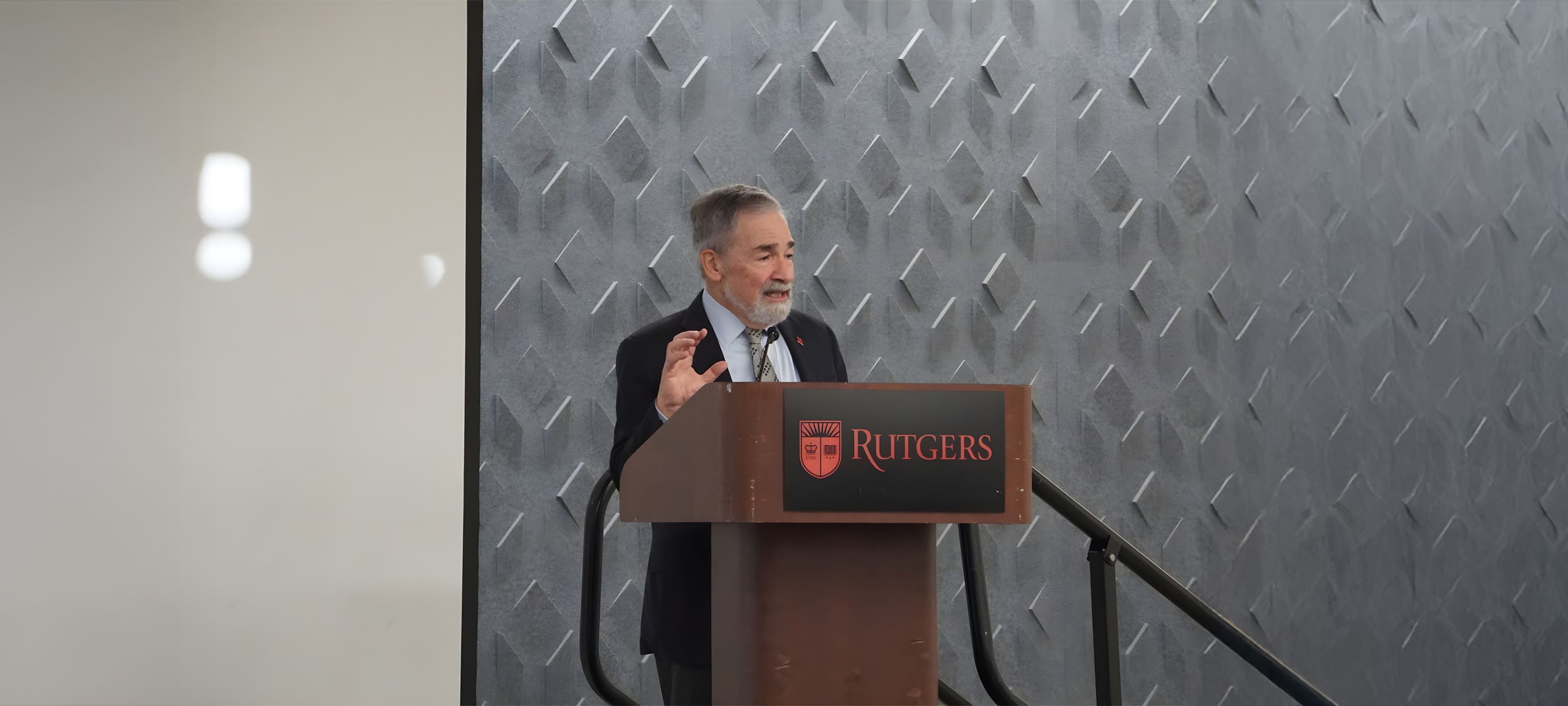
As the Brain Health Institute (BHI) marked its 11th Annual Symposium, the program began with a moment that felt both celebratory and reflective. BHI Director Gary Aston-Jones opened by recognizing Rutgers Health Chancellor Brian L. Strom, who stepped down at the end of 2025—and whose leadership has helped shape the Institute’s trajectory from the beginning.
Gary put it plainly: the growth and progress BHI has experienced as a neuroscience community is due in large part to Chancellor Strom’s support. Not only through resources, but through steady guidance—being accessible, staying engaged, and serving as a trusted sounding board as BHI built momentum across Rutgers.
Chancellor Strom’s remarks underscored what that kind of leadership makes possible: a research enterprise with national standing, a culture built for collaboration, and a mission grounded in improving lives.
A clear model for what an academic medical center should be
Chancellor Strom called the Brain Health Institute “one of the true gems of Rutgers Health, and of Rutgers University as a whole,” emphasizing that BHI’s strength is not only in the science it produces, but in how it works—interdisciplinary at its core, collaborative by design, and relentlessly focused on real-world impact.
That distinction matters. Brain health challenges—Alzheimer’s disease, autism, addiction, chronic pain, neurodegenerative disorders—do not fit neatly inside one discipline. They require clinicians and basic scientists working alongside engineers, data experts, behavioral scientists, and community partners. In Strom’s view, BHI has become a model for that integrated approach, helping Rutgers deliver the kind of team-based progress that moves discoveries closer to patients and families.
Growth that signals national competitiveness in neuroscience
One of the most striking measures of BHI’s rise is research funding—a proxy for scientific confidence, competitiveness, and capacity.
Chancellor Strom highlighted a clear before-and-after story: in 2014, before BHI was established, Rutgers received about $30 million in annual NIH funding for neuroscience and brain health research. Today, in fiscal year 2025, that number has grown to more than $105 million.
That growth is not simply an internal milestone. It signals that Rutgers is increasingly recognized at the national level for neuroscience research that is ambitious, collaborative, and capable of delivering results. Strom noted that the broader Rutgers Health research enterprise has also expanded significantly, and he emphasized an important message for the moment: even amid uncertainty at the federal level, high-performing institutions continue to compete strongly for support. For researchers, trainees, and partners, it was a reminder that the work—and the momentum behind it—remains real.
The most meaningful outcome: hope that reaches people
For all the talk of funding and rankings, Strom returned to a more human measure of success: people served.
The power of brain health research is its ability to translate into hope—new approaches, better tools, and stronger pathways to prevention and care for conditions that touch nearly every family. Strom framed BHI’s work as ultimately about impact: advancing knowledge in ways that can change what patients experience and what clinicians can offer.
That emphasis—science in service of lives—has long been central to BHI’s identity. Strom’s remarks reinforced it as the Institute’s clearest throughline: discovery with a purpose, pursued at the scale and pace the public need demands.
Building the talent and infrastructure that make breakthroughs possible
Momentum is built by people—and by the structures that enable them to work together.
Chancellor Strom pointed to BHI’s role in recruiting and supporting outstanding faculty across Rutgers. Since 2018, BHI has recruited 48 exceptional faculty members who have collectively brought in more than $110 million in grant awards. That kind of talent expansion strengthens the full ecosystem: more labs, more interdisciplinary teams, more mentorship for trainees, and more capacity to translate science into solutions.
He also noted that this growth has helped establish centers of excellence across key areas of brain health, bringing together clinicians, scientists, and engineers. These centers are not just organizational achievements—they are engines for cross-disciplinary work, designed to accelerate discovery by making collaboration the default rather than the exception.
A farewell rooted in gratitude—and confidence in what comes next
When Chancellor Strom spoke about stepping down, he did so with pride in what has been built—and gratitude for the community that built it. He thanked Gary Aston-Jones for the vision and leadership that helped shape BHI into a national force, and he thanked the faculty, staff, trainees, and collaborators whose work advances Rutgers Health every day.
The most lasting part of his message was the combination of appreciation and expectation: appreciation for what BHI has already accomplished, and expectation for what this community will do next.
BHI joins Gary—and the broader Rutgers community—in thanking Chancellor Brian Strom for the partnership, steady advocacy, and strategic leadership that helped propel a decade of growth in neuroscience and brain health at Rutgers. His impact is visible in the Institute’s expanding research portfolio, its interdisciplinary culture, and its ever-stronger ability to translate science into meaningful outcomes.
Make A Difference
Support the Brain Health Institute’s research, training, and community impact
